Theoretically, one can assume that a certain number of photographs have no other purpose than to unintentionally capture light.
MAX KOZLOFF, Photography and Fascination, 1979.
Imagine we set up a photo camera that automatically takes a picture every single minute. On the photographic film, we would obtain a homogeneous grayish black, more or less chaotic patches and other marks perhaps in the shape of a plant or a partial or entire animal. These are all photographs. Everyday, millions like these are taken. Everyone knows that many pictures are interesting scientifically, sociologically, or even aesthetically speaking. There is nothing exceptional about this. Accredited photographers enjoy clicking their cameras without looking in the viewfinder, and the journalist who is able to shoot his celebrity over the head or between the legs of the reporter next to him employs a similar method, especially since the camera is triggered in bursts. We will therefore consider aleatory photographs as minimal instances of photography.
What do we learn from this? That, in a photograph, there are always luminous imprints, that is to say, photons coming from outside to leave a mark on the light-sensitive film. Thus, there was an event, a photographic event: the collision of photons with the light-sensitive film. This, indeed, did take place. To ascertain whether this physicochemical event corresponded to a spectacle of objects and actions, of which the imprinted photons would be the signs to the extent they were emitted by them, is much more problematic and calls for careful consideration. Do I see the reality of past things and actions? Were only a certain number of photons emitted according to an artificial and strict system of selection?
All the inexactitudes in theories of photography can be attributed to the rash overlooking of the strange status of those very direct and veritable luminous photonic imprints, which are but the very indirect and abstract imprints of objects. We will therefore attempt to enumerate and describe the characteristics as scrupulously as possible, while keeping in mind that this is the place where everything is played out.
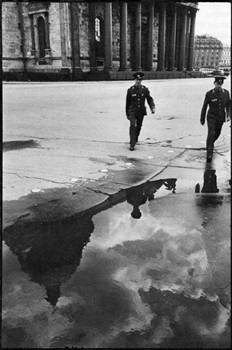 |
Cartier-Bresson:
Leningrad
|
Mr. Biot agrees with Mr. Arago that the preparation of Mr. Daguerre will furnish new and desirable means for studying the properties of one of the natural agents that concern us most and that so far we only had few means of subjecting to independent examination through our senses.
Report of the Science Academy, meeting of 7 January 1839.
1A. THE PHOTONIC IMPRINT : WEIGHTLESSNESS
The majority of imprints under discussion are the result of an impact, like the tracks of a boar in the mud, or the more or less prolonged material contact with a substance, as in stains smudging a cloth. The photon that traverses the optical glass and alters the halides of the film is not really a substance and it does not produce an impact. It carries energy, but has no mass. Indeed, we can also see this when after sunbathing we carry the marks of the bathing suit, transforming us into photograms. The weightlessness of photons endows their inscriptions with a striking weightlessness, almost an immateriality. Tanning is not a form of make-up.
1B. THE DISTANT IMPRINT : SUPERFICIALITY OF FIELD
The photons impregnating the light-sensitive film come from light-emitting sources located in a certain volume (the depth of field) and at a distance away from the photographic device, thereby creating a first abstraction. This distant volume is defined by a plane where the reflected or emitted photons have the best differentiation on the film. This is the focal plane "statistically localizable in the result" which creates a second abstraction. The depth of field photons that do not belong to this privileged plane are situated in a space relevant to their loss of differentiation, and the spatialization thus created becomes all the more abstracted the more this loss increases. This loss not only grows beyond the ideal plane but equally on the ideal plane itself. What is called depth of field can equally be called superficiality of field. And superficiality does not say much either because the word makes one think of a slice or a (histological) section, or of an insubstantial but designatable frame of reference. Considering the evanescence of such a reference, we can only put our trust in an indirect and statistical approach of the plane of high differentiation. If it signals an external spectacle, it can only do so in a very abstract fashion.
1C. THE FRAMED IMPRINT
The photographic imprint is marked off by a margin, which has nothing to do with the frame-trap which the ancient painter used to focus their environment, or with the architect's active clipping of surroundings. It is a simple impassible limit. Simply a lateral and vertical that in themselves have nothing to do with the direct imprint of photons, and even less with the indirect imprint of the possible spectacle, and that can have no other plastic effect other than on what it contains and not on its exterior, in keeping with the all-powerful ignorance of anything on the outside of the frame. Still, it is necessary to note that this limit is made of rectilinear borders that intersect at a right angle. It could equally have been circular, as the form of lenses suggest.
Undoubtedly, this rectangularity was necessary to arrange the haziness and evanescence referred to above with respect to the depth (superficiality) of field. Be that as it may, our rectangular margin will inevitably integrate certain portions of the imprint while clouding others. The limit is therefore also abstractive, but only in moderation. The frame-limit of the photograph contains neither the violence of sampling nor that of engraving. It is a break without drama on a surface of inscription.
1D. ISOMORPHIC IMPRINTS
Photographic photons, focalized by optical lenses according to relentlessly constant deviations, obey continuous equations. This regularity allows the rigorous positioning of their sources, and thus also a prospective spectacle, in accordance with spatial coordinates, as can be seen in geological and astronomical photographs. But simultaneously it subtracts from spectacle its local accentuation which would render it a true place. Besides being monocular (cyclopean), the photograph is also isomorphic. As it is rigorously spatial, it is always a non-place.
1E. THE SYNCHRONOUS IMPRINT
Also, a photographic imprint can be dated close to a billionth of a second. Regardless of the time of exposure and the moment of impact of each specific photon, their appearance is ultimately datable by the arrival of the last of the photons. In case of a moving source and therefore also a possible spectacle, the succession of incoming photons can never give rise to what has always judiciously called movement. Thus, much in the same way the isomorphism of lenses and imprints evacuates the concrete place by replacing it with a purely localizable space, the alignment toward the passage of the last photon expels concrete duration, substituting it with a physical and exclusively datable time (tn).
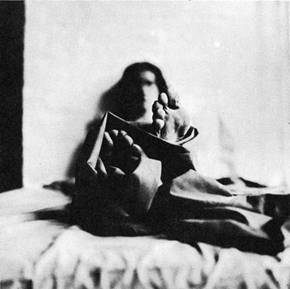 |
Mapplethorpe : Feet, 1976, in "Creatis" n° 7.
|
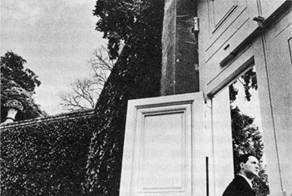 |
Den Hollander, Nouvelle
Photographie Hollandaise, Contre-jour.
|
1F. THE POSITIVE-NEGATIVE IMPRINT : PULSATION
Ultimately, a positive is the negative of the negative. From this double conversion, every print retains a hesitance between darkness and light, the opaque and the transparent, the convex and the concave, conferring onto the print a kind of flutter. This fluttering or pulsation introduces a new form of abstraction in which the positive invites a reading as negative, and vice versa. This explains our characterization that lacing and engraving are the photographic themes par excellence. And this also explains the particular fascination with backlighting, which is the negative of the negative of the negative.
1G. ANALOGICAL AND DIGITAL IMPRINTS
In the dark and light stains of a figurative photograph, one can recognize forms that share proportions (analogies) with those of an outside spectacle indirectly signalized by the imprinted photons: therefore, these stains are analogical. But, at the same time, they are obtained through the conversion of each single silver halidic grains governed by the choice between darkened/non-darkened, that is to say, a choice between yes or no, 0/1: therefore, photographs are also digital (calculable). And this digitality, already apparent in all photographic proofs, becomes almost ostentatious in enlarged prints in which the graining becomes flagrant. Once again, what could be naively concrete is the result of abstraction. I clearly see that the Big Dipper, which I perceive analogically, is presented to me solely in the form of a statistically examinable distribution of grains. So much so that, if on this photograph of a region of the sky I fail to recognize a constellation or a well-known or possible star, I can always, as astronomer, numerically (digitally) study the distribution of darker points there to see if there would not be singularities deviating from the expected average value, thus attesting to the presence of possible objects.
1H. SURCHARGED AND SUBCHARGED IMPRINTS
In some respects, every photograph is disinformed. If we compare the visual singularities of the spectacle and what remains of it on the photographic imprint, the loss of information will be considerable, while colors (dozens instead of thousands) and lines become a sort of sharpened stains. But, conversely, even a mediocre photograph of the facades I pass every day in my street will reveal, thanks to its immobility and its accessibility to my sight, thousands of things that my perception, unstable and purposeful as it is, had never noticed there before. And this is yet another abstraction in relation to the concrete of everyday existence of these simultaneously filtered and superabundant representations.
If one agrees to accept the eight qualities of texture and structure we have just considered, one may notice that each one in particular and all of them together contribute in endowing the photograph with two apparently opposite characteristics: an extreme spectacular clarity in some respects, and an extreme blurring in other respects. Moreover, the link between the blurred and the clear is symmetrical: the eventual spectacle always appears in its emergence from the non-spectacle. In other words, information is rendered as emerging fragilely and problematically out of noise, background noise. All the properties of the photograph and its functioning are inevitably organized within this polarity and this convection.
Henri Van Lier